



Search results for "witwit"
Items in stock - 4 working days delivery time

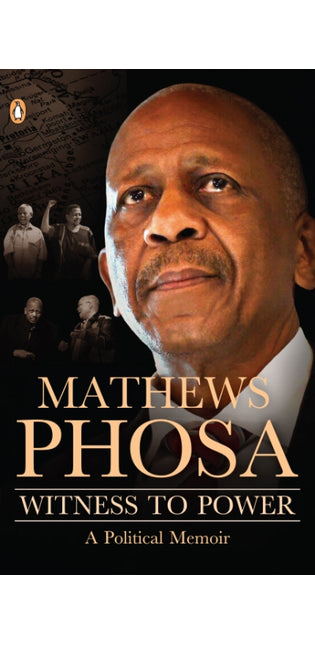
Witness to Power
Mathews Phosa has been an eyewitness to the dramatic shifts of political power in South Africa. He was involved in the Black Consciousness Movement, the UDF and the ANC, before fleeing into exile in 1985 and becoming an Umkhonto weSizwe commander in Mozambique. A lawyer by training, he was one of the first ANC members to return to South Africa to prepare the way for negotiations. He was premier of Mpumalanga during the presidency of Nelson Mandela, with whom he had a strong relationship. Under Thabo Mbeki, whom he had known in exile, Phosa was pushed to the sidelines, with false accusations that he was involved in a ‘plot’ to overthrow the president. Phosa had served under Jacob Zuma as an MK field commander in Mozambique, and he became treasurer-general of the ANC when Zuma became its president at Polokwane. But Phosa later became a vocal critic of Zuma, and they didn’t speak for years, until the night before Zuma’s resignation. Phosa and Cyril Ramaphosa had studied law together at the University of the North in the 1970s, and fifty years later Phosa played a key role in advising him over the Phala Phala report that threatened to end his presidency. Witness to Power is a gripping story of underground activities, military operations, negotiations, political conflict and intrigue. It provides fascinating new insights into the ruling party and its leaders by an ANC elder who worked with them all.
R 330.00
Wicked Wit of England
The Wicked Wit of England is a celebration of British humour, featuring a collection of stories, anecdotes, quips and quotes that capture the various idiosyncrasies of the English character.If there is one thing that first-time visitors to England find mystifying – along with our obsession with discussing the weather, our pride in making the perfect cup of tea, and our impossible-to-decipher slang – it is our unique sense of humour. Have you just been insulted? Or was the slight merely a demonstration of affection? Was that a genuine compliment? Or is the ever-present sarcasm in English conversation at work again? The dark, dry and often ironic humour of the English can be difficult to get your head around, but there’s no doubting its essentiality at the heart of English culture. As well as celebrating this classic humour, The Wicked Wit of England encompasses the various idiosyncrasies of the English character – the social awkwardness, the constant need to apologize, the stiff upper lip, and the love of queuing, to name but a few. Containing a varied collection of stories, anecdotes, quips and quotes featuring English people from all walks of life, from Quentin Crisp to Frank Skinner and Stephen Hawking to Thora Hird, this book might not help outsiders fully understand the English, but it might help them tolerate us a little more.
R 85.00
Items we need to order for you
Soul of Wit
A delicious collection of the very best of wit, satire and humorous quotations about the Church, its clergy, the people who put up with them - and vice versa. Spanning the centuries from Chaucer to the present day, it is a glorious send tup of the human foibles that so often get in the way when the Church tries to live up to its calling. Many familiar figures from literature and letters are included, but there are endless surprises and novelties too, making The Soul of Wit not only a book to give great pleasure, but an essential resource for speakers, writers and preachers too.
R 479.00
Arguments of Augustan Wit
Comic and satiric literature from the 1670s to the 1740s is characterized by the allusive and elusive word play of Augustan wit. The arguments of Augustan wit reveal preoccupations with the metaphorical dimension of language so distrusted by Locke and others who saw it as fundamentally opposed to the rational mode of judgement. John Sitter makes a challenging claim for the importance of wit in the writings of Dryden, Rochester, Prior, Berkeley, Gay, Pope and Swift, as an analytic mode as well as one of stylistic sophistication. He argues that wit - often regarded by modern critics as a quaint category of verbal cleverness - in fact offers to literary theory a legacy corrective of Romantic and neo-Romantic idealizations of imagination. This study aims at once to emphasize the historical specificity of Augustan writing, and to bring its arguments into dialogue with those of our time.
R 1,747.77
Metaphysical Wit
English metaphysical poetry, from Donne to Marvell, is notoriously witty. In this 1992 book, A. J. Smith seeks the reason for the central importance of wit in the thinking of the metaphysical poets and argues that metaphysical wit is essentially different from other modes of wit current in Renaissance Europe. Formal theories and rhetorics of wit are considered both for their theoretical import and their appraisals of wit in practice. Prevailing fashions of witty invention are scrutinized in Italian, French and Spanish writings, so as to bring out the nature and effect of various forms of wit: conceited, hieroglyphic, transformational and others from which the metaphysical mode is distinguished. He locates the basis of Renaissance wit in the received conception of the created order and a theory of literary innovation inherent in Humanist belief, which led to novel couplings of time and eternity, body and soul, man and God.
R 2,083.98
Profane Wit
A biography of the poet and libertine the Earl of Rochester.Of the glittering, licentious court around King Charles II, John Wilmot, the second Earl of Rochester, was the most notorious. Simultaneously admired and vilified, he personified the rake-hell. Libertine, profane, promiscuous, heshocked his pious contemporaries with his doubts about religion and his blunt verses that dealt with sex or vicious satiric assaults on the high and mighty of the court. This account of Rochester and his times provides the facts behind his legendary reputation as a rake and his deathbed repentance. However, it also demonstrates that he was a loving if unfaithful husband, a devoted father, a loyal friend, a serious scholar, a social critic, and an aspiring patriot. An Emeritus Professor of English at the University of Rochester, James William Johnson is the author or editor of nine books and many articles treating British and American Literature.
R 1,621.41
Witness
#1 New York Times bestseller for 13 consecutive weeks! "As long as humanity speaks of virtue and dreams of freedom, the life and writings of Whittaker Chambers will ennoble and inspire." - PRESIDENT RONALD REAGAN "One of the dozen or so indispensable books of the century..." - GEORGE F. WILL "Witness changed my worldview, my philosophical perceptions, and, without exaggeration, my life." - ROBERT D. NOVAK, from his Foreward "Chambers has written one of the really significant American autobiographies. When some future Plutarch writes his American Live, he will find in Chambers penetrating and terrible insights into America in the early twentieth century." - ARTHUR SCHLESINGER JR. "Chambers had a gift for language....to call Chambers an activist or Witness a political event is to say Dostoevsky was a criminologist or Crime and Punishment a morality tract." - WASHINGTON POST "Chambers was not just the witness against Alger Hiss, but was also one of th articulators of the modern conservative philosophy, a philosophy that has something to do with restoring the spiritual values of politics." - SAM TANENHAUS, author of Whittaker Chambers "One of the few indispensable autobiographies ever written by an American - and one of the best written, too." - HILTON KRAMER, The New Criterion First published in 1952, Witness is the true story of Soviet spies in America and the trial that captivated a nation. Part literary effort, part philosophical treatise, this intriguing autobiography recounts the famous Alger Hiss case and reveals much more. Chambers' worldview and his belief that "man without mysticism is a monster" went on to help make political conservatism a national force. Regnery History's Cold War Classics edition is the most comprehensive version of Witness ever published, featuring forewords collected from all previous editions, including discussions from luminaries William F. Buckley Jr., Robert D. Novak, Milton Hindus, and Alfred S. Regnery.
R 684.00
R 1,676.00
R 367.00
R 358.00
R 341.00
R 397.00
Twitter Wit
"Twitter Wit" is the first compilation of Twitter aphorisms, with submissions ranging from quotidian vignettes like 'I bet in Sweden the Ikea instructions are in English' to bumper sticker-type quips like 'I think the bird of love is the dove. My husband thinks it's the swallow,' and contributors ranging from celebrities like Shaquille O'Neal, Jimmy Fallon, Penn Jillette, John Cleese, and Steven Fry to regular people with previously unappreciated sharp tongues. Featuring a foreword by Twitter co-founder Biz Stone, this authorised anthology of the thousand most clever and memorable 'tweets' relates the diversity of human experience in hilarious bite-sized pieces.
R 391.00
R 244.00
Texas Wit & Wisdom
Texas Wit & Wisdom is a barrel of laughs crammed into one little ol' book. Inside you'll find a friendly collection of hundreds of anecdotes, humorous stories, wild tales, and even some surprising wisdom from the often wacky, but always wonderful, world of the Lone Star State. Wallace Chariton, a fifth generation native Texan and author of several books on Texas, has carefully collected the best examples of Texas fun and humor and put them all together in this book, the ultimate collection of Texas humor.
R 605.08
R 367.00
R 574.65
R 1,412.93
R 642.00
R 456.00
R 597.10
R 458.00
R 229.00
R 1,066.00
R 911.00
Ridicule, Religion and the Politics of Wit in Augustan England
Arguing for the importance of wit beyond its use as a literary device, Roger D. Lund outlines the process by which writers in Restoration and eighteenth-century England struggled to define an appropriate role for wit in the public sphere. He traces its unpredictable effects in works of philosophy, religious pamphlets, and legal writing and examines what happens when literary wit is deliberately used to undermine the judgment of individuals and to destabilize established institutions of church and state. Beginning with a discussion of wit's association with deception, Lund suggests that suspicion of wit and the imagination emerges in attacks on the Restoration stage, in the persecution of The Craftsman, and in criticism directed at Thomas Hobbes's Leviathan and works by writers like the Earl of Shaftesbury, Thomas Woolston, and Thomas Paine. Anxieties about wit, Lund shows, were in part responsible for attempts to suppress new communal venues such as coffee houses and clubs and for the Church's condemnation of the seditious pamphlets made possible by the lapse of the Licensing Act in 1695. Finally, the establishment's conviction that wit, ridicule, satire, and innuendo are subversive rhetorical forms is glaringly at play in attempts to use libel trials to translate the fear of wit as a metaphorical transgression of public decorum into an actual violation of the civil code.
R 9,313.65
R 419.64
Ridicule, Religion and the Politics of Wit in Augustan England
Arguing for the importance of wit beyond its use as a literary device, Roger D. Lund outlines the process by which writers in Restoration and eighteenth-century England struggled to define an appropriate role for wit in the public sphere. He traces its unpredictable effects in works of philosophy, religious pamphlets, and legal writing and examines what happens when literary wit is deliberately used to undermine the judgment of individuals and to destabilize established institutions of church and state. Beginning with a discussion of wit's association with deception, Lund suggests that suspicion of wit and the imagination emerges in attacks on the Restoration stage, in the persecution of The Craftsman, and in criticism directed at Thomas Hobbes's Leviathan and works by writers like the Earl of Shaftesbury, Thomas Woolston, and Thomas Paine. Anxieties about wit, Lund shows, were in part responsible for attempts to suppress new communal venues such as coffee houses and clubs and for the Church's condemnation of the seditious pamphlets made possible by the lapse of the Licensing Act in 1695. Finally, the establishment's conviction that wit, ridicule, satire, and innuendo are subversive rhetorical forms is glaringly at play in attempts to use libel trials to translate the fear of wit as a metaphorical transgression of public decorum into an actual violation of the civil code.
R 2,834.62
R 642.24
R 419.64
R 1,208.26
R 912.00
R 183.00
R 790.67
R 658.24
Profane Wit
A biography of the poet and libertine the Earl of Rochester.Of the glittering, licentious court around King Charles II, John Wilmot, the second Earl of Rochester, was the most notorious. Simultaneously admired and vilified, he personified the rake-hell. Libertine, profane, promiscuous, heshocked his pious contemporaries with his doubts about religion and his blunt verses that dealt with sex or vicious satiric assaults on the high and mighty of the court. This account of Rochester and his times provides the facts behind his legendary reputation as a rake and his deathbed repentance. However, it also demonstrates that he was a loving if unfaithful husband, a devoted father, a loyal friend, a serious scholar, a social critic, and an aspiringpatriot. An Emeritus professor of English at the University of Rochester, James William Johnson is the author or editor of nine books and many articles treating British and American Literature.
R 1,337.92
R 458.00
R 762.00
R 909.00
Virtue of Wit
In The Virtue of Wit: Humor, Social Connection, and Flourishing, Clair Morrissey argues that wit is a form of social ingenuity, an aptitude for building and maintaining human connection. Her novel account of wit understands it as the capacity for joining people in feeling through playful, amusing creativity with words and behaviors. In animating and enlivening our everyday shared social landscape, exercising wit is partially constitutive of living a good human life. Through analysis of the history of philosophical treatments of wit and related concepts, contemporary empirical and theoretical research on humor, and examples drawn from across the narrative arts and standup comedy, Morrissey argues that wit should be considered a proper moral virtue. Her analysis illuminates how virtue ethicists can embrace a non-ideal ethical framework that centers the joy and flourishing of marginalized or oppressed people. The exercise of wit can play an important role in asserting and celebrating one’s humanity in everyday resistance to oppression.
R 3,847.00
R 1,173.73
R 2,440.00
R 1,524.00
R 457.00


