


BESTSELLERS

"Beyond the Law"
In nineteenth-century England, sodomy was punishable by death; even an accusation could damage a man’s reputation for life. The last executions for this private, consensual act were in 1835, but the effort to change the law that allowed for those executions was intense and precarious, and not successful until 1861. In this groundbreaking book, “Beyond the Law,” noted historian Charles Upchurch pieces together fragments from history and uses a queer history methodology to recount the untold story of the political process through which the law allowing for the death penalty for sodomy was almost ended in 1841.Upchurch recounts the legal and political efforts of reformers like Jeremy Bentham and Lord John Russell—the latter of whom argued that the death penalty for sodomy was “beyond the law and above the law.” He also reveals that a same-sex relationship linked the families of the two men responsible for co-sponsoring the key legislation. By recovering the various ethical, religious, and humanitarian arguments against punishing sodomy, “Beyond the Law” overturns longstanding assumptions of nineteenth-century British history. Upchurch demonstrates that social change came from an amalgam of reformist momentum, family affection, elitist politics, class privilege, enlightenment philosophy, and personal desires.
R 1,291.00
R 455.00
R 679.00
R 455.00
R 213.00
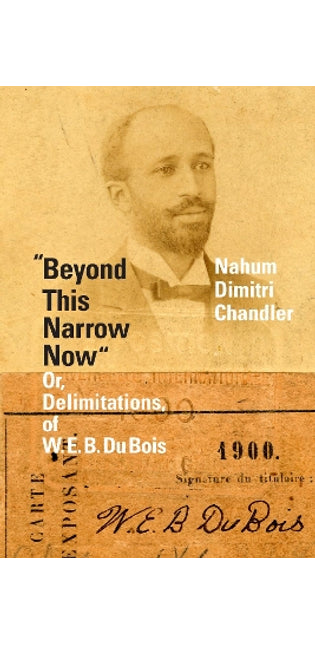
"Beyond This Narrow Now"
In “Beyond This Narrow Now” Nahum Dimitri Chandler shows that the premises of W. E. B. Du Bois's thinking at the turn of the twentieth century stand as fundamental references for the whole itinerary of his thought. Opening with a distinct approach to the legacy of Du Bois, Chandler proceeds through a series of close readings of Du Bois's early essays, previously unpublished or seldom studied, with discrete annotations of The Souls of Black Folk: Essays and Sketches of 1903, elucidating and elaborating basic epistemological terms of his thought. With theoretical attention to how the African American stands as an example of possibility for Du Bois and renders problematic traditional ontological thought, Chandler also proposes that Du Bois's most well-known phrase—“the problem of the color line”—sustains more conceptual depth than has yet been understood, with pertinence for our accounts of modern systems of enslavement and imperial colonialism and the incipient moments of modern capitalization. Chandler's work exemplifies a more profound engagement with Du Bois, demonstrating that he must be re-read, appreciated, and studied anew as a philosophical writer and thinker contemporary to our time.
R 3,924.00
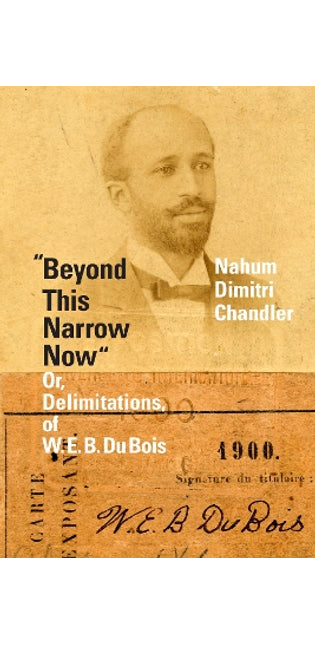
"Beyond This Narrow Now"
In “Beyond This Narrow Now” Nahum Dimitri Chandler shows that the premises of W. E. B. Du Bois's thinking at the turn of the twentieth century stand as fundamental references for the whole itinerary of his thought. Opening with a distinct approach to the legacy of Du Bois, Chandler proceeds through a series of close readings of Du Bois's early essays, previously unpublished or seldom studied, with discrete annotations of The Souls of Black Folk: Essays and Sketches of 1903, elucidating and elaborating basic epistemological terms of his thought. With theoretical attention to how the African American stands as an example of possibility for Du Bois and renders problematic traditional ontological thought, Chandler also proposes that Du Bois's most well-known phrase—“the problem of the color line”—sustains more conceptual depth than has yet been understood, with pertinence for our accounts of modern systems of enslavement and imperial colonialism and the incipient moments of modern capitalization. Chandler's work exemplifies a more profound engagement with Du Bois, demonstrating that he must be re-read, appreciated, and studied anew as a philosophical writer and thinker contemporary to our time.
R 1,053.00
R 385.00
R 679.00
R 776.00
R 496.00
R 682.00
R 613.00
R 334.00
R 531.00
R 2,418.00
R 1,130.00
R 1,212.00
R 606.00
R 455.00
R 451.00
R 394.00
"Birth" of Italy
Scholarship has widely debated the question about the existence of an 'Italian identity' in the time of the Roman Republic, basing on the few sources available and on the outcomes of the Augustan and imperial age. In this sense, this debate has for a long time been conducted without sufficient imput from social sciences, and particularly from social geography, which has developed methodologies and models for the investigation of identities. This book starts therefore from the consideration that Italy came to be, by the end of the Republic, a region within the Roman imperium, and investigates the ways this happened and its consequences on the local populations and their identity structures. It shows that Italy gained a territorial and symbolic shape, and own institutions defining it as a territorial region, and that a regional identity developed as a consequence by the 2nd century BCE. The original, interdisciplinary approach to the matter allows a consistent revision of the ancient sources and sheds now light on the topic, providing important reflections for future studies on the subject.
R 7,481.00
R 679.00
R 453.00
R 394.00
R 327.00
R 303.00