


CHILDREN

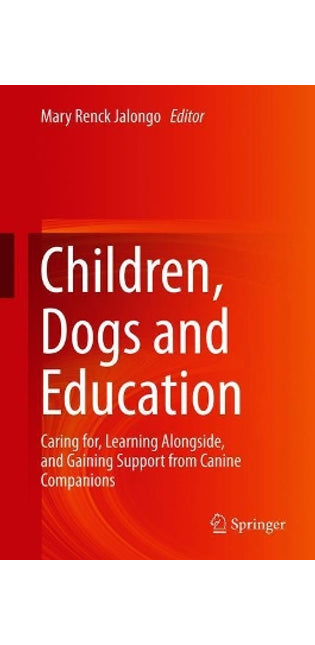
Children, Dogs and Education
This book brings together authoritative information about the child/dog bond as it is manifested with family dogs, visiting therapy dogs, and service dogs trained to assist children with disabilities. Despite the widely accepted view that participating in a dog’s care and interacting with dogs in behaviorally healthy ways is a route to becoming responsible and compassionate, research on this complex dynamic is difficult to design, time-consuming to collect, and challenging to analyze. This volume synthesizes theory, research, and practice, bringing all to bear upon child/dog interactions in homes, schools, libraries, and the community at large. Children, Dogs and Education serves as a handbook for a diverse group of adults who seek to build positive relationships between children and dogs—parents/families, professional dog trainers, teachers, librarians, mental health professionals, health care professionals, and university faculty.The study of interactions between human and nonhuman animals has captured the imagination of an international community of researchers from many different fields and professions. Even though dogs are ubiquitous in the lives of most children, studies of children’s interactions with dogs in families and communities are lacking. Most of the previous research on the human-canine bond has focused on adolescents and adults or, even when younger children are the focus, it has tended to rely on parents to speak for children. There are three features of this book that make it unique. First, it goes beyond exploring the child/dog bond to examine additional important issues, including: children’s concepts of responsible care, their ability to interpret dogs’ behavioral cues, and their ideas about canine behavioral issues/training. Second, unlike most other work to date, it represents children’s voices through cases, interviews, and drawings. Finally, the contributors to this edited work use their collective wisdom to draw educational implications and suggest direction in preparing the next generation of dog guardians.
R 5,089.00
R 997.00
R 1,209.00
R 576.00
R 1,343.00
Children, Gender and Families in Mediterranean Welfare States
countries in this region have been particularly limited (for an exception to this, see Petmesidou & Papatheodorou, 2006). The underlying assumption in this volume is that despite the diversity of welfare states bordering the Mediterranean Sea, some interesting commonalities are shared by these nations. Indeed, in his contribution to this volume Gal has described these nations as belonging to an extended family of welfare states that share some common characteristics and outcomes, one of which is the role of the family. By bringing together case analyses of the welfare states in the Mediterranean which focus on children, gender, and families, we maintain that it is possible to shed light on aspects of social policy that do not necessarily emerge in most discussions of these issues in the literature. The rationale inherent in a volume that focuses on a group of welfare states is of course embedded in the welfare regime typology notion that has dominated much of the comparative social policy literature over the last two decades. The publication of Esping Andersen’s seminal work, The Three Worlds of Welfare Capitalism in 1990 (and his related 1999 book), which distinguished between three welfare regimes, became a landmark for comparative work of social policies in various countries. Esping-Andersen regarded his typology as a useful tool for comparison between welfare states because it allowed “for greater analytical parsimony and help[s] us to see the forest rather than myriad trees” (1999, p. 73).
R 3,998.00
R 477.00
Children, Development and Education
Historical anthropology is a revision of the German philosophical anthropology under the influences of the French historical school of Annales and the Anglo-Saxon cultural anthropology. Cultural-historical psychology is a school of thought which emerged in the context of the Soviet revolution and deeply affected the disciplines of psychology and education in the 20th century. This book draws on these two schools to advance current scholarship in child and youth development and education. It also enters in dialogue with other relational approaches and suggests alternatives to mainstream western developmental theories and educational practices.This book emphasizes communication and semiotic processes as well as the use of artifacts, pictures and technologies in education and childhood development, placing a special focus on active subjectivity, historicity and performativity. Within this theoretical framework, contributors from Europe and the U.S. highlight the dynamic and creative aspects of school, family and community practices and the dramatic aspects of child development in our changing educational institutions. They also use a series of original empirical studies to introduce different research methodologies and complement theoretical analyses in an attempt to find innovative ways to translate cultural-historical and historical anthropological theory and research into a thorough understanding of emerging phenomena in school and after-school education of ethnic minorities, gender-sensitive education, and educational and family policy. Divided into two main parts, “Culture, History and Child Development”, and “Gender, Performativity and Educational Practice”, this book is useful for anyone in the fields of cultural-historical research, educational science, educational and developmental psychology, psychological anthropology, and childhood and youth studies.
R 3,998.00
R 243.00