


BESTSELLERS

R 425.00
R 324.00
R 281.00
R 364.00
R 523.00
R 303.00
R 516.00
R 719.00
R 1,097.00
R 742.00
R 455.00
R 2,068.00
R 163.00
R 299.00
R 364.00
R 303.00
R 303.00
R 243.00
R 341.00
R 358.00
R 462.00
R 382.00
"Poor Paris!"
Since the Kierkegaard Studies Monograph Series (KSMS) was first published in 1997, it has served as the authoritative book series in the field. Starting from 2011 the Kierkegaard Studies Monograph Series will intensify the peer-review process with a new editorial and advisory board. KSMS is published on behalf of the Søren Kierkegaard Research Centre at the University of Copenhagen. KSMS publishes outstanding monographs in all fields of Kierkegaard research. This includes Ph.D. dissertations, Habilitation theses, conference proceedings and single author works by senior scholars. The goal of KSMS is to advance Kierkegaard studies by encouraging top-level scholarship in the field. The editorial and advisory boards are deeply committed to creating a genuinely international forum for publication which integrates the many different traditions of Kierkegaard studies and brings them into a constructive and fruitful dialogue. To this end the series publishes monographs in English and German. Potential authors should consult the Submission guidelines. All submissions will be blindly refereed by established scholars in the field. Only high-quality manuscripts will be accepted for publication. Potential authors should be prepared to make changes to their texts based on the comments received by the referees.
R 6,215.00
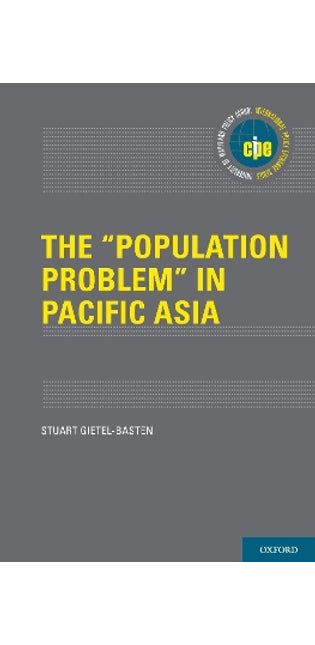
"Population Problem" in Pacific Asia
Despite the twenty-first century's often being referred to as the Asian Century-indicating hope for economic growth and the rebalancing of the global order-population aging and stagnation present an existential threat to the success of China and other territories of Pacific Asia (namely Japan, Taiwan, Hong Kong, Singapore, and South Korea). This book argues that the "population problem," rooted in low fertility, has thus far been largely considered in a linear way:low fertility leads to population stagnation and rapid aging, so fixing low fertility should correct the problem. However, a multi-dimensional lens is essential to appreciating the scale and nature of the issue-and, indeed, to determining whether it is an issue at all. Stuart Gietel-Basten examineshow the issue of low fertility has been constructed, how blame has been apportioned, and why policies designed to tackle it have yielded few results. Drawing on an array of primary and secondary sources as well as examples from scholarly and popular literature,The "Population Problem" in Pacific Asia takes a comparative approach to fertility in the region and locates mainland China in its regional context. It serves as a useful resource for government workers, stakeholders, andstudents and scholars in sociology, demography, geography, economics, and area studies.
R 3,147.00
R 489.00
R 2,294.00
R 2,294.00
R 2,294.00
R 2,294.00