Rebels and Revolutionaries

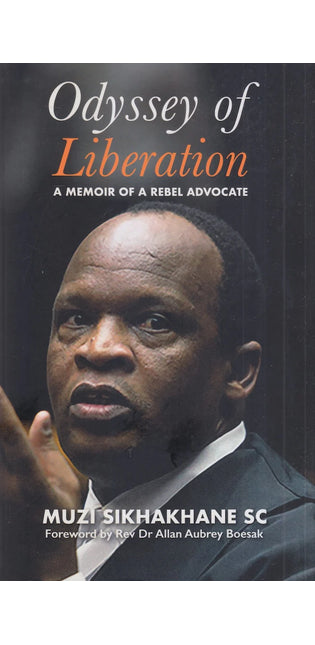
Odyssey of Liberation
Sikhakhane masterfully unveils a prism through which the social injustices shaping South Africa today are starkly revealed. Drawing from his remarkable career as a Black man navigating the complexities of life in South Africa, he explores the unresolved historical injustices and conflicting interests that have led the nation to its precarious state. He delves into the paradox of liberation, where the pursuit of change is consistently undermined by an entrenched desire to preserve the status quo. Sikhakhane argues that this approach prioritizes safeguarding White privilege and the interests of White capital, often at the expense of true progress. With fervor, he critiques the pervasive hold of White power, the fractured promise of liberation, and the insidious narratives that vilify the oppressed while absolving the real perpetrators of systemic injustice. Rooted in activism and philosophical insight, this thought-provoking and inspirational book offers a captivating exploration of South Africa’s socio-political landscape. Sikhakhane’s journey is as enlightening as it is motivational, providing invaluable lessons for anyone who loves South Africa or seeks a deeper understanding of the intricate power dynamics shaping modern Africa.
I Write What l Like
I Write What I Like features the writing of the famous activist and Black Consciousness leader, Steve Biko. Before his untimely death in detention at age 30, he was instrumental in uniting Black Africans in the struggle against the apartheid government in South Africa. This 40th anniversary edition includes a Foreword by Njabulo S. Ndebele, personal reflections on Steve Biko and Black Consciousness, as well as Biko’s first known published piece of writing. In addition, it features all the material of the original Picador Africa edition: a collection of Biko’s columns entitled I Write What I Like published in the journal of the South Africa Student Organisation under the pseudonym of ‘Frank Talk’; other journal articles, interviews and letters written by Steve Biko at the time; an Introduction by Nkosinathi Biko; a preface by Archbishop Desmond Tutu; and a moving memoir by Father Aelred Stubbs, which pays tribute to the courage and power of this young leader, who was to become one of Africa’s heroes.
R 270.00
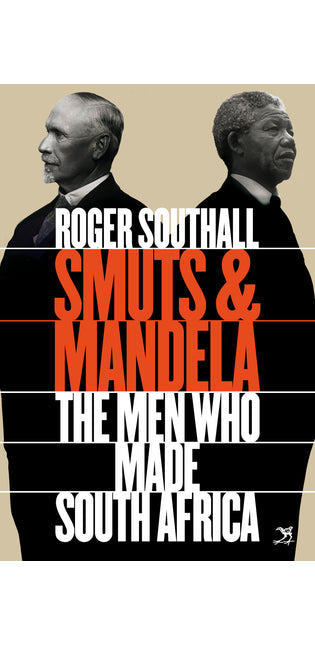
Smuts and Mandela
South Africa has produced two leaders who achieved global recognition and renown in their respective eras: Jan Christian Smuts (Prime Minister, 1919–24 and 1939–48) and Nelson Rolihlahla Mandela (President, 1994–99). The former was much celebrated for playing a significant role in re-constructing international architecture after both world wars; the latter remains globally admired for his leading part in drawing South Africa back from racial war and becoming a democracy. As a result, both have attracted multiple biographies. Today, however, whereas Mandela remains a much-admired global icon, Smuts’ reputation is much diminished, with contemporary historians citing his racism and role in constructing the foundations of apartheid South Africa. In this controversial book, Roger Southall provides a re-evaluation of Smuts’s hugely contradictory career by proposing fascinating parallels with the life and political trajectory of Mandela. Both came to maturity as political leaders as freedom fighters, Smuts against the British and Mandela against the apartheid regime. Both played a pre-eminent role in founding a ‘new South Africa’, the first made for whites at Union in 1910 and the second for all South Africans in 1994. Both aspired to be nation-builders, but while Smuts’s hoped-for South African nation was white, Mandela aspired to bring all South Africa’s people together. Both came into stride on the international stage, albeit in very different ways and for various reasons. Smuts’s career failed, and he was ejected from office. Mandela retired gracefully from office and continued to be lauded for his well-earned retirement, yet South Africa’s contemporary travails reveal his hopes and policies as unfulfilled. This book makes the case that we cannot fully understand Mandela without first understanding Smuts and how South Africa continues to struggle with the legacy he left behind.
R 390.00
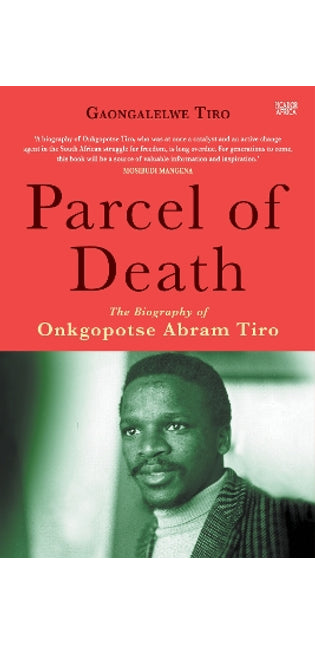
Parcel of Death
On 29 April 1972, Tiro made one of the most consequential revolutionary addresses in South African history. Dubbed the Turfloop Testimony, Tiro’s anti-apartheid speech saw him and many of his fellow student activists expelled, igniting a series of strikes in tertiary institutions across the country. By the time he went into exile in Botswana, Tiro was president of the Southern African Student Movement (SASM), permanent organiser of the South African Student Organisation (SASO) and a leading Black Consciousness proponent, hailed by many as the ‘godfather’ of the June 1976 uprisings.
R 310.00
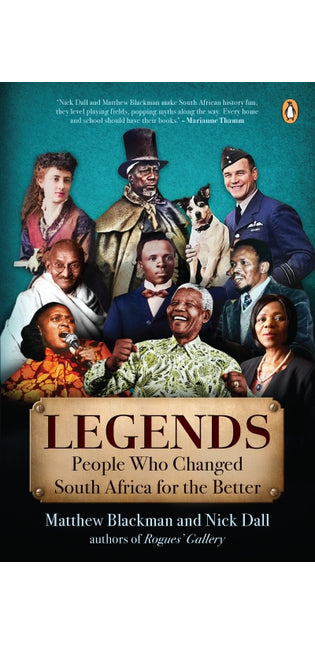
Legends
We have a lot to be positive about in South Africa. With all our problems, it’s easy to feel bleak. But hold those thoughts, because Legends might be just the tonic you need to drive off the gloom. This book tells the stories of a dozen remarkable people – some well known, others largely forgotten – who changed Mzansi for the better. Most South Africans are proud of Nelson Mandela – and rightly so. His life was truly astounding, but he’s by no means the only person who should inspire us. There’s King Moshoeshoe, whose humanity and diplomatic strategies put him head and shoulders above his contemporaries, both European and African. And John Fairbairn, who brought non-racial democracy to the Cape in 1854. Olive Schreiner was a bestselling international author who fought racism, corruption and chauvinism. And Gandhi spent twenty years here inventing a system of protest that would bring an Empire to its knees. Legends also celebrates Eugène Marais’s startling contributions to literature and natural history (despite a lifelong morphine addiction); Sol Plaatje’s wit, intelligence and tenacity in the face of racial zealots; Cissie Gool’s lifetime fighting for justice and exposing bigots; and Sailor Malan’s battles against fascists in the skies of Europe and on the streets of South Africa. Legends also celebrates Eugène Marais’s startling contributions to literature and natural history (despite a lifelong morphine addiction); Sol Plaatje’s wit, intelligence and tenacity in the face of racial zealots; Cissie Gool’s lifetime fighting for justice and exposing bigots; and Sailor Malan’s battles against fascists in the skies of Europe and on the streets of South Africa. And then there’s Miriam Makeba, who began her life in prison and ended it as an international singing sensation; Steve Biko, who shifted the minds of an entire generation; and Thuli Madonsela (the book’s only living legend), who gracefully felled the most powerful man in the land. Engagingly written and meticulously researched, Legends reminds South Africans that we have a helluva lot to be proud of.
R 360.00
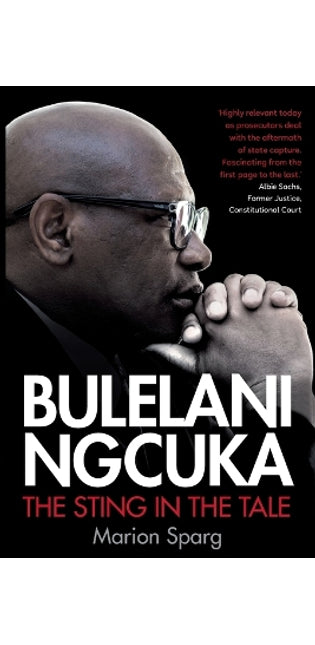
Bulelani Ngcuka
"Highly relevant today as prosecutors deal with the aftermath of State Capture. Fascinating from the first page to the last." - Albie Sachs, Former Justice, Constitutional Court Courageous, yet contested, Bulelani Ngcuka has always stood up for what he believes in. His decision in 2003 as National Director of Public Prosecutions not to prosecute then deputy president, Jacob Zuma, is a decision he still stands by to this day. In this sweeping biography, based on many hours of interviews with Ngcuka, author Marion Sparg uncovers the roots of his fearless activism and tells his side of the story. She goes back in time to his modest beginnings in the Eastern Cape, to his lawyering years with the formidable Griffiths Mxenge, his various periods of detention, exile, and his homecoming. Ngcuka played a critical role in establishing the National Prosecuting Authority, the elite crime-busting unit the Scorpions, and other mechanisms to tackle the country's crime and corruption problems. Soon he faced one of his most difficult tasks - confronting former comrades who had become involved in illegal activities. The Sting in the Tale is a first-hand account of our most recent legal and political history. It is also an intriguing story about political manoeuvrings, bombings and hijackings, urban-terror and "whispering" campaigns, lies, murder, alleged spies, intrigue, family, and love.
R 310.00
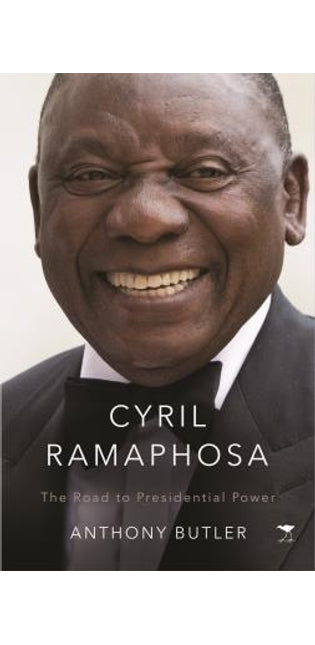
Cyril Ramaphosa
President Cyril Ramaphosa is South Africa’s fifth post-apartheid president. He first came to prominence in the 1980s as the founder of the National Union of Mineworkers (NUM). When Nelson Mandela was released from prison in February 1990, Ramaphosa was at the head of the reception committee that greeted him. Chosen as secretarygeneral of the African National Congress in 1991, Ramaphosa led the ANC’s team to negotiate the country’s post-apartheid constitution. Thwarted in his ambition to succeed Mandela, he exchanged political leadership for commerce, ultimately becoming one of the country’s weathiest businessmen, a breeder of exotic cattle and a philanthropist. This fully revised and extended edition charts Ramaphosa’s earlylife and education, and his career in trade unionism, politics and constitution-building. Extensive new chapters explore his contribution to the NationalPlanning Commission, the effects of the Marikana massacre on his political prospects and the real story behind his rise to the deputy presidency of the country in 2014. They set out the constraints Ramaphosa faced as Jacob Zuma’s deputy, and explain how he ultimately triumphed in the election of the ANC’s new president in 2017. The book concludes with an analysis of the challenges Ramaphosa faces as the country’s fifth post-apartheid president. This commanding biography tells the full story of this enigmatic leader’s life and political career for the first time. It is based on numerous personal conversations with Ramaphosa over the past decade, and on rich interviews with many of the subject’s friends and contemporaries.
R 360.00
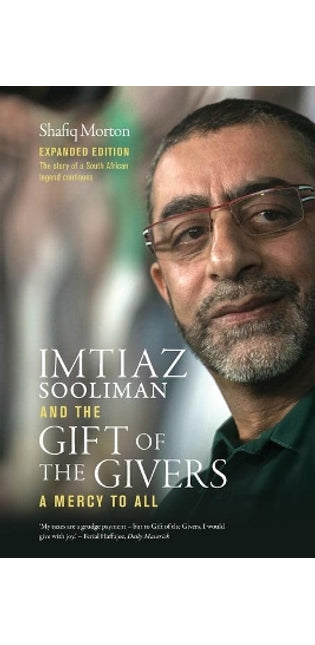
Imtiaz Sooliman and the Gift Of the Givers
Imtiaz Sooliman, a medical doctor practising in Pietermaritzburg, South Africa, visited a Shaikh in Istanbul in 1992. The Sufi teacher gave him a message that would dramatically change the lives of countless people. ‘To my absolute astonishment he told me I would help people for the rest of my life. He then instructed me to form a humanitarian organisation called the “Gift of the Givers”, and repeated the phrase “the best among people are those who benefit mankind”.’ Almost 30 years later Gift of the Givers, Africa’s largest humanitarian and disaster agency, has a reputation for speedy responses to floods, war, famine, fires, tsunamis, kidnapping and earthquakes. Well known for their interventions in South African and international disasters, teams of volunteers have undertaken missions to places such as Bosnia, Palestine, Japan, Haiti, Indonesia, Malawi and Mozambique. In the last few years they have turned their attention to the poorest South Africans - they have put up hospitals, run clinics, dug wells, drilled boreholes, built houses, offered scholarships and provided shelter, food and psychological succour to millions. Originally published in 2014, the book has been brought up to date to continue the extraordinary tale of an organisation that has become a South African legend – the first to intervene in so many devastating situations and bring hope to those who have lost everything. Gift of the Givers’ reputation for direct, honest and non-partisan solution-finding has become a beacon of hope in South Africa.
R 370.00
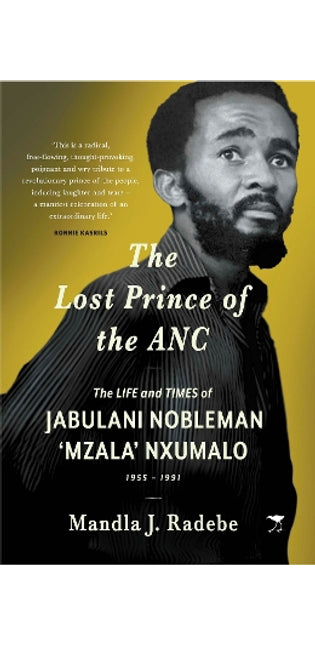
Lost Prince of the ANC
Mandala J. Radebe has written the first, full account of the South African revolutionary, Jabulani Nobleman ‘Mzala’ Nxumalo. Intimate and analytical, this powerful and searching biography of one of the liberation movement’s chief critical thinkers, writer and constant questioner, The Lost Prince of the ANC traces Mzala’s life from birth to his untimely death in London in 1991, at the age of 35. Radebe’s insightful life of Mzala, is the story too, of the radical tradition of the liberation movement, which flourished during its underground days. This revolutionary book, of an intellectual who had much to offer the post-apartheid South Africa, does more than fill a gap in our history: its insight opens a door for the reader to imagine politics and society anew.
R 350.00