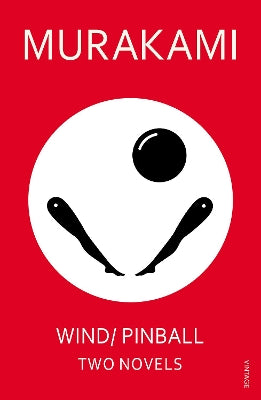
Discover Haruki Murakami's first two novels.'If you're the sort of guy who raids the refrigerators of silent kitchens at three o'clock in the morning, you can only write accordingly. That's who I am.' Hear the Wind Sing and Pinball, 1973 are Haruki Murakami's earliest novels. They follow the fortunes of the narrator and his friend, known only by his nickname, the Rat. In Hear the Wind Sing the narrator is home from college on his summer break. He spends his time drinking beer and smoking in J's Bar with the Rat, listening to the radio, thinking about writing and the women he has slept with, and pursuing a relationship with a girl with nine fingers. Three years later, in Pinball, 1973, he has moved to Tokyo to work as a translator and live with indistinguishable twin girls, but the Rat has remained behind, despite his efforts to leave both the town and his girlfriend. The narrator finds himself haunted by memories of his own doomed relationship but also, more bizarrely, by his short-lived obsession with playing pinball in J's Bar. This sends him on a quest to find the exact model of pinball machine he had enjoyed playing years earlier: the three-flipper Spaceship.
CONTRIBUTORS: Ted Goossen, Haruki MurakamiEAN: 9780099590392COUNTRY: United KingdomPAGES: WEIGHT: 234 gHEIGHT: 198 cm
PUBLISHED BY: Vintage PublishingDATE PUBLISHED: 2016-05-03CITY: GENRE: FICTION / Literary, FICTION / Cultural Heritage, FICTION / Magical Realism, FICTION / Friendship, FICTION / World Literature / JapanWIDTH: 129 cmSPINE:
Book Themes:
Japan, Modern and contemporary fiction: general and literary, Magical realism, Narrative theme: Love and relationships, Fiction in translation
Murakami fans will no doubt delight in this new publication. For newcomers, these early works are an excellent introduction to a writer who has since become one of the most influential novelists of his generation, Murakami’s way of making emotionally resonant images and symbols bump around on the page, and in one’s mind, remains fresh, miraculously, more than 35 years on, Wind/Pinball is a fresh, heart-warming dose of the Japanese master, To read a Murakami book is to feel comforted by the familiarity and predictability of its strangeness. These are Murakami’s two earliest novels and so, like archaeological artefacts, they detail the early construction of his now-famous style., quintessential Murakami… an excellent introduction to a writer who has since become one of the most influential novelists of his generation
In 1978, Haruki Murakami was twenty-nine and running a jazz bar in downtown Tokyo. One April day, the impulse to write a novel came to him suddenly while watching a baseball game. That first novel, Hear the Wind Sing, won a new writers' award and was published the following year. More followed, including A Wild Sheep Chase and Hard-Boiled Wonderland and the End of the World, but it was Norwegian Wood, published in 1987, that turned Murakami from a writer into a phenomenon. In works such as The Wind-Up Bird Chronicle, 1Q84, What I Talk About When I Talk About Running and Men Without Women, Murakami's distinctive blend of the mysterious and the everyday, of melancholy and humour, continues to enchant readers, ensuring his place as one of the world's most acclaimed and well-loved writers.
Format:
Discover Haruki Murakami's first two novels.'If you're the sort of guy who raids the refrigerators of silent kitchens at three o'clock in the morning, you can only write accordingly. That's who I am.' Hear the Wind Sing and Pinball, 1973 are Haruki Murakami's earliest novels. They follow the fortunes of the narrator and his friend, known only by his nickname, the Rat. In Hear the Wind Sing the narrator is home from college on his summer break. He spends his time drinking beer and smoking in J's Bar with the Rat, listening to the radio, thinking about writing and the women he has slept with, and pursuing a relationship with a girl with nine fingers. Three years later, in Pinball, 1973, he has moved to Tokyo to work as a translator and live with indistinguishable twin girls, but the Rat has remained behind, despite his efforts to leave both the town and his girlfriend. The narrator finds himself haunted by memories of his own doomed relationship but also, more bizarrely, by his short-lived obsession with playing pinball in J's Bar. This sends him on a quest to find the exact model of pinball machine he had enjoyed playing years earlier: the three-flipper Spaceship.
CONTRIBUTORS: Ted Goossen, Haruki MurakamiEAN: 9780099590392COUNTRY: United KingdomPAGES: WEIGHT: 234 gHEIGHT: 198 cm
PUBLISHED BY: Vintage PublishingDATE PUBLISHED: 2016-05-03CITY: GENRE: FICTION / Literary, FICTION / Cultural Heritage, FICTION / Magical Realism, FICTION / Friendship, FICTION / World Literature / JapanWIDTH: 129 cmSPINE:
Book Themes:
Japan, Modern and contemporary fiction: general and literary, Magical realism, Narrative theme: Love and relationships, Fiction in translation
In 1978, Haruki Murakami was twenty-nine and running a jazz bar in downtown Tokyo. One April day, the impulse to write a novel came to him suddenly while watching a baseball game. That first novel, Hear the Wind Sing, won a new writers' award and was published the following year. More followed, including A Wild Sheep Chase and Hard-Boiled Wonderland and the End of the World, but it was Norwegian Wood, published in 1987, that turned Murakami from a writer into a phenomenon. In works such as The Wind-Up Bird Chronicle, 1Q84, What I Talk About When I Talk About Running and Men Without Women, Murakami's distinctive blend of the mysterious and the everyday, of melancholy and humour, continues to enchant readers, ensuring his place as one of the world's most acclaimed and well-loved writers.
Die man van elders, ’n titel wat onmiddellik my verbeelding geprikkel het. Gelukkig het die skrywer, die geliefde Helene de Kock, reeds so vroeg as op bladsy 27 vir die lesers ’n leidraad gegee oor haar gedagtegang wat betref Jean Botha: “Elders is iewers en tegelyk nêrens. En is dit nie waar hy nou is nie?” Dan neem die storielyn sy loop, en baie later kan Jean op sy eie stukkie grond staan en verklaar: “Ja, ek is die man van Elders. Soos Ou Paul sê, daar waar dit mooiweer en warm is.” (p.264)”
Die verhaal is veel meer as net een man se soeke na ’n plek waar hy behoort. Dit is ook die verhaal van Renette Brink wat met een oogopslag Jean se hart gesteel het, maar die prooi word van huishoudelike geweld en ’n narsis. “Haar man is verslaaf aan homself.” (p.211) Dit moes Renette op die harde manier agterkom. Nie ’n tema wat jou in die gehoor streel nie, maar sonder omhaal weergegee.
Daar is gelukkig ook baie heilsame aspekte in die storielyn ingebou soos ware vriendskap en aanvaarding sonder vooroordeel, tweede kanse, opoffering en dankbaarheid. Die geestelike pad wat die hoofkarakters loop, word ook subtiel bygewerk in die styl waarvoor hierdie skrywer bekend is.
Die man van elders is die derde in ’n reeks en volg op Diana se dag en Drome het ook asem. Moet glad nie bekommerd wees as jy die eerste twee nie gelees het nie, hierdie verhaal kan op eie bene staan. Dit sal egter ’n bonus wees as jy hulle sommer al drie in volgorde kan lees.
Human & Rousseau is die uitgewers. Dit is ’n druknaam van Jonathan Ball Uitgewers
"Big Dreams, Big Travel" is an consistently exciting adventure that immediately draws you into a mysterious dream world. Wim Balmer writes clearly, directly, and without unnecessary length – you practically fly through the pages. Jay's journey between dream and reality is intense, surprising, and makes you eager to keep reading.
A great fantasy book for young readers who want to dive straight into the adventure. Entertaining, dreamy, and absolutely recommended.
Extremely helpful - hundreds of topics covered.
2 Examples:
- Consider everything already broken.
Everything breaks, even rocks eventually become sand. So don't stress about it when somethings breaks! You knew it was going to happen!
- Beware of the mushroom effect of your thoughts. (She probably thinks this now. She's probably telling everybody. Now, this person will... etc)