Search results for "Thomas H Russell"
Items we need to order for you

Virtuous Pagans
This book, first published in 1991, examines the unreligious of America. Most sociologists of religion viewed religious belief and behaviour as having strong positive function for individual well-being – with the implicit assumption that unreligious individuals would lack meaning in life. This book applies statistical approaches to modelling causality as it analyses a controversial topic in American sociology.
R 1,535.60
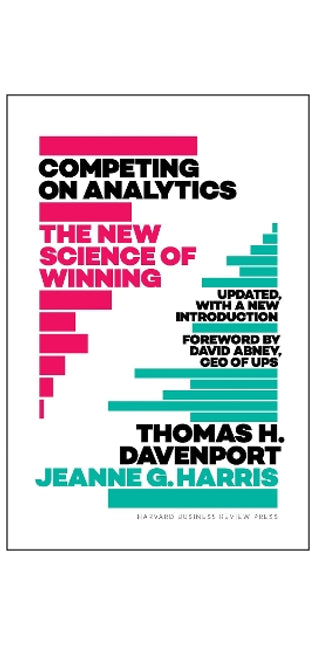
Competing on Analytics: Updated, with a New Introduction
The New Edition of a Business ClassicThis landmark work, the first to introduce business leaders to analytics, reveals how analytics are rewriting the rules of competition.Updated with fresh content, Competing on Analytics provides the road map for becoming an analytical competitor, showing readers how to create new strategies for their organizations based on sophisticated analytics. Introducing a five-stage model of analytical competition, Davenport and Harris describe the typical behaviors, capabilities, and challenges of each stage. They explain how to assess your company’s capabilities and guide it toward the highest level of competition. With equal emphasis on two key resources, human and technological, this book reveals how even the most highly analytical companies can up their game.With an emphasis on predictive, prescriptive, and autonomous analytics for marketing, supply chain, finance, M&A, operations, R&D, and HR, the book contains numerous new examples from different industries and business functions, such as Disney’s vacation experience, Google’s HR, UPS’s logistics, the Chicago Cubs’ training methods, and Firewire Surfboards’ customization. Additional new topics and research include:Data scientists and what they doBig data and the changes it has wroughtHadoop and other open-source software for managing and analyzing dataData products—new products and services based on data and analyticsMachine learning and other AI technologiesThe Internet of Things and its implicationsNew computing architectures, including cloud computingEmbedding analytics within operational systemsVisual analyticsThe business classic that turned a generation of leaders into analytical competitors, Competing on Analytics is the definitive guide for transforming your company’s fortunes in the age of analytics and big data.
R 798.00
Virtuous Pagans
This book, first published in 1991, examines the unreligious of America. Most sociologists of religion viewed religious belief and behaviour as having strong positive function for individual well-being – with the implicit assumption that unreligious individuals would lack meaning in life. This book applies statistical approaches to modelling causality as it analyses a controversial topic in American sociology.
R 4,458.56
Analytics at Work
Most companies have massive amounts of data at their disposal, yet fail to utilize it in any meaningful way. But a powerful new business tool - analytics - is enabling many firms to aggressively leverage their data in key business decisions and processes, with impressive results. In their previous book, Competing on Analytics, Thomas Davenport and Jeanne Harris showed how pioneering firms were building their entire strategies around their analytical capabilities. Rather than "going with the gut" when pricing products, maintaining inventory, or hiring talent, managers in these firms use data, analysis, and systematic reasoning to make decisions that improve efficiency, risk-management, and profits. Now, in Analytics at Work, Davenport, Harris, and coauthor Robert Morison reveal how any manager can effectively deploy analytics in day-to-day operations--one business decision at a time. They show how many types of analytical tools, from statistical analysis to qualitative measures like systematic behavior coding, can improve decisions about everything from what new product offering might interest customers to whether marketing dollars are being most effectively deployed.Based on all-new research and illustrated with examples from companies including Humana, Best Buy, Progressive Insurance, and Hotels.com, this implementation-focused guide outlines the five-step DELTA model for deploying and succeeding with analytical initiatives. You'll learn how to: * Use data more effectively and glean valuable analytical insights * Manage and coordinate data, people, and technology at an enterprise level * Understand and support what analytical leaders do * Evaluate and choose realistic targets for analytical activity * Recruit, hire, and manage analysts Combining the science of quantitative analysis with the art of sound reasoning, Analytics at Work provides a road map and tools for unleashing the potential buried in your company's data.
R 798.00
Keeping Up with the Quants
Why Everyone Needs Analytical Skills Welcome to the age of data. No matter your interests (sports, movies, politics), your industry (finance, marketing, technology, manufacturing), or the type of organization you work for (big company, nonprofit, small start-up)--your world is awash with data. As a successful manager today, you must be able to make sense of all this information. You need to be conversant with analytical terminology and methods and able to work with quantitative information. This book promises to become your "quantitative literacy" guide--helping you develop the analytical skills you need right now in order to summarize data, find the meaning in it, and extract its value. In Keeping Up with the Quants, authors, professors, and analytics experts Thomas Davenport and Jinho Kim offer practical tools to improve your understanding of data analytics and enhance your thinking and decision making.You'll gain crucial skills, including: * How to formulate a hypothesis * How to gather and analyze relevant data * How to interpret and communicate analytical results * How to develop habits of quantitative thinking * How to deal effectively with the "quants" in your organization Big data and the analytics based on it promise to change virtually every industry and business function over the next decade. If you don't have a business degree or if you aren't comfortable with statistics and quantitative methods, this book is for you. Keeping Up with the Quants will give you the skills you need to master this new challenge--and gain a significant competitive edge.
R 798.00
All-in On AI
A Wall Street Journal bestsellerA Publisher's Weekly bestsellerA fascinating look at the trailblazing companies using artificial intelligence to create new competitive advantage, from the author of the business classic, Competing on Analytics, and the head of Deloitte's US AI practice.Though most organizations are placing modest bets on artificial intelligence, there is a world-class group of companies that are going all-in on the technology and radically transforming their products, processes, strategies, customer relationships, and cultures.Though these organizations represent less than 1 percent of large companies, they are all high performers in their industries. They have better business models, make better decisions, have better relationships with their customers, offer better products and services, and command higher prices.Written by bestselling author Tom Davenport and Deloitte's Nitin Mittal, All-In on AI looks at artificial intelligence at its cutting edge from the viewpoint of established companies like Anthem, Ping An, Airbus, and Capital One.Filled with insights, strategies, and best practices, All-In on AI also provides leaders and their teams with the information they need to help their own companies take AI to the next level.If you're curious about the next phase in the implementation of artificial intelligence within companies, or if you're looking to adopt this powerful technology in a more robust way yourself, All-In on AI will give you a rare inside look at what the leading adopters are doing, while providing you with the tools to put AI at the core of everything you do.
R 798.00
Information Ecology
According to virtually every business writer, we are in the midst of a new "information age," one that will revolutionize how workers work, how companies compete, perhaps even how thinkers think. And it is certainly true that Information Technology has become a giant industry. In America, more that 50% of all capital spending goes into IT, accounting for more than a third of the growth of the entire American economy in the last four years. Over the last decade, ITspending in the U.S. is estimated at 3 trillion dollars. And yet, by almost all accounts, IT hasn't worked all that well. Why is it that so many of the companies that rave invested in these costly new technologies never saw the returns they had hoped for? And why do workers, even CEOs, find it so hardto adjust to new IT systems? In Information Ecology, Thomas Davenport proposes a revolutionary new way to look at information management, one that takes into account the total information environment within an organization. Arguing that the information that comes from computer systems may be considerably less valuable to managers than information that flows in from a variety of other sources, the author describes an approach that encompasses the company's entire information environment, the management of whichhe calls information ecology. Only when organizations are able to combine and integrate these diverse sources of information, and to take them to a higher level where information becomes knowledge, will they realize the full power of their information ecology. Thus, the author puts people, not technology,at the centre of the information world. Information and knowledge are human creations, he points out, and we will never excel at managing them until we give people a primary role. Citing examples drawn from his own extensive research and consulting including such major firms as A.T. & T., American Express, Ford, General Electric, Hallmark, Hoffman La Roche, IBM, Polaroid, Pacific Bell, and Toshiba Davenport illuminates the critical components of information ecology, and at every step alongthe way, he provides a quick assessment survey for managers to see how their organization measures up. He discusses the importance of developing an overall strategy for information use; explores the infighting, jealousy over resources, and political battles that can frustrate information sharing;underscores the importance of looking at how people really use information (how they search for it, modify it, share it, hoard it, and even ignore it) and the kinds of information they want; describes the ideal information staff, who not only store and retrive information, but also prune, provide context, enhance style, and choose the right presentation medium (in an age of work overload, vital information must be presented compellingly so the appropriate people recognize and use it); examineshow information management should be done on a day to day basis; and presents several alternatives to the machine
R 3,790.00
AI Advantage
Cutting through the hype, a practical guide to using artificial intelligence for business benefits and competitive advantage. In The AI Advantage, Thomas Davenport offers a guide to using artificial intelligence in business. He describes what technologies are available and how companies can use them for business benefits and competitive advantage. He cuts through the hype of the AI craze-remember when it seemed plausible that IBM's Watson could cure cancer?-to explain how businesses can put artificial intelligence to work now, in the real world. His key recommendation: don't go for the "moonshot" (curing cancer, or synthesizing all investment knowledge); look for the "low-hanging fruit" to make your company more efficient. Davenport explains that the business value AI offers is solid rather than sexy or splashy. AI will improve products and processes and make decisions better informed-important but largely invisible tasks. AI technologies won't replace human workers but augment their capabilities, with smart machines to work alongside smart people. AI can automate structured and repetitive work; provide extensive analysis of data through machine learning ("analytics on steroids"), and engage with customers and employees via chatbots and intelligent agents. Companies should experiment with these technologies and develop their own expertise. Davenport describes the major AI technologies and explains how they are being used, reports on the AI work done by large commercial enterprises like Amazon and Google, and outlines strategies and steps to becoming a cognitive corporation. This book provides an invaluable guide to the real-world future of business AI. A book in the Management on the Cutting Edge series, published in cooperation with MIT Sloan Management Review.
R 743.00