


BESTSELLERS

R 665.00
R 423.00
R 758.00
R 277.00
R 364.00
R 580.00
R 1,000.00
R 385.00
"No deixes que cresca sense la magia dels contes..."
Contes de 0 a 9 anys, que eduquen en valors actuals: respecte, pluralitat, tolerancia i igualtat d'oportunitats; que ajudaran a evitar mals com la violencia de genere o l'assetjament.
R 609.00
R 303.00
R 606.00
R 303.00
R 303.00
R 514.00
R 387.00
R 387.00
R 679.00
R 303.00
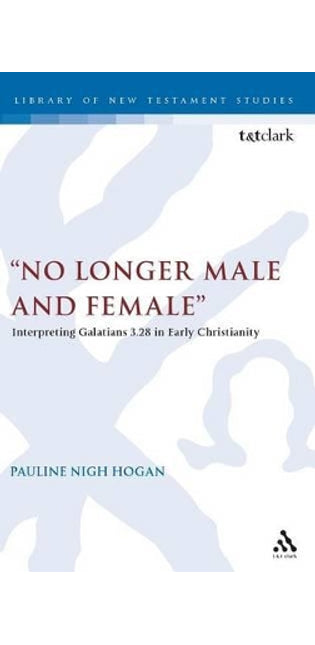
"No Longer Male and Female"
Galatians 3:28, in particular the phrase, "There is ...no longer male and female; for you all are one in Christ Jesus," would seem to point towards an ethos of gender equality among Christians. Acting on this assumption, a number of scholars have considered the phrase significant in reconstructing attitudes towards women in early Christianity. Until now, however, a study of the history of interpretation of Gal 3:28 has been lacking. The exploration of the post-New Testament career of the verse is therefore the focus of this book. The approach is historical-critical, discussing the exegesis of Gal 3:28 in the context of attitudes about the roles of women in the first four centuries CE. This study reveals that early Christians did not always approach this verse with the same concerns as modern readers. Ancient commentators brought several different questions to their discussion of Gal 3:28, and it is impossible to discover the trajectory in exegesis of this verse that might have been expected.It becomes apparent that during the first four centuries of Christianity most writers treated Gal 3:28 as a statement about the identification of Christians with Christ and therefore an indication that in the resolution of various differences into unity, they could achieve an ideal state. While some writers applied this concept to status differences between men and women, others used it to discuss the qualities of the ideal disciple, the character of the first created human beings, the state of the believer in heaven, and even the nature of God.
R 6,715.00
"No Love Lost"
No Love Lost, the next best selling novel to hit the book stores. The author, J. W. Smith captures the street life of a young man, with similarities resembling his own life. Beginning with the early childhood of "Lil Jay, and on into his manhood, Smith brings the gut wrenching truth, of rigid living in a ghastly neighborhood and a twist of enlightenment to urban literature.
R 516.00
R 303.00
R 775.00
R 1,162.00
R 606.00
R 1,687.00
R 470.00
R 667.00
R 406.00
R 373.00
"No One Helped"
In "No One Helped" Marcia M. Gallo examines one of America's most infamous true-crime stories: the 1964 rape and murder of Catherine "Kitty" Genovese in a middle-class neighborhood of Queens, New York. Front-page reports in the New York Times incorrectly identified thirty-eight indifferent witnesses to the crime, fueling fears of apathy and urban decay. Genovese's life, including her lesbian relationship, also was obscured in media accounts of the crime. Fifty years later, the story of Kitty Genovese continues to circulate in popular culture. Although it is now widely known that there were far fewer actual witnesses to the crime than was reported in 1964, the moral of the story continues to be urban apathy. "No One Helped" traces the Genovese story's development and resilience while challenging the myth it created."No One Helped" places the conscious creation and promotion of the Genovese story within a changing urban environment. Gallo reviews New York's shifting racial and economic demographics and explores post–World War II examinations of conscience regarding the horrors of Nazism. These were important factors in the uncritical acceptance of the story by most media, political leaders, and the public despite repeated protests from Genovese's Kew Gardens neighbors at their inaccurate portrayal. The crime led to advances in criminal justice and psychology, such as the development of the 911 emergency system and numerous studies of bystander behaviors. Gallo emphasizes that the response to the crime also led to increased community organizing as well as feminist campaigns against sexual violence. Even though the particulars of the sad story of her death were distorted, Kitty Genovese left an enduring legacy of positive changes to the urban environment.
R 4,234.00
"No One Helped"
In "No One Helped" Marcia M. Gallo examines one of America's most infamous true-crime stories: the 1964 rape and murder of Catherine "Kitty" Genovese in a middle-class neighborhood of Queens, New York. Front-page reports in the New York Times incorrectly identified thirty-eight indifferent witnesses to the crime, fueling fears of apathy and urban decay. Genovese's life, including her lesbian relationship, also was obscured in media accounts of the crime. Fifty years later, the story of Kitty Genovese continues to circulate in popular culture. Although it is now widely known that there were far fewer actual witnesses to the crime than was reported in 1964, the moral of the story continues to be urban apathy. "No One Helped" traces the Genovese story's development and resilience while challenging the myth it created."No One Helped" places the conscious creation and promotion of the Genovese story within a changing urban environment. Gallo reviews New York's shifting racial and economic demographics and explores post–World War II examinations of conscience regarding the horrors of Nazism. These were important factors in the uncritical acceptance of the story by most media, political leaders, and the public despite repeated protests from Genovese's Kew Gardens neighbors at their inaccurate portrayal. The crime led to advances in criminal justice and psychology, such as the development of the 911 emergency system and numerous studies of bystander behaviors. Gallo emphasizes that the response to the crime also led to increased community organizing as well as feminist campaigns against sexual violence. Even though the particulars of the sad story of her death were distorted, Kitty Genovese left an enduring legacy of positive changes to the urban environment.
R 1,050.00
R 243.00
R 451.00
R 589.00
R 928.00
R 606.00
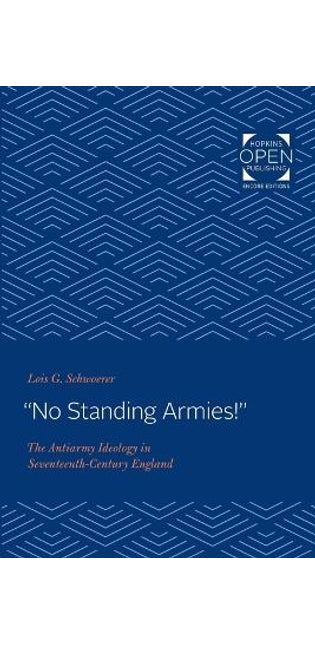
"No Standing Armies!"
Originally published in 1974. In her study of primary materials in England and the United States, Schwoerer traces the origin, development, and articulation in both Parliament and in the popular press of the attitude opposing standing armies in seventeenth-century England and the American colonies. Central to the criticism of armies at that time was the conviction that ultimate military power should be vested in Parliament, not the Crown. Schwoerer shows how the many diverse elements of England's antimilitarism, including political principle, propaganda, parliamentary tactics, parochialism, and partisanship, hardened with every confrontation between the Crown or Protector and Parliament. The author finds a general predisposition to distrust professional soldiers early in the century, and from the 1620s onward she notes opposition to a standing army in times of peace. Highlighting the growth of the antimilitary tradition, Schwoerer traces the development of this attitude from the Petition of Right in 1628 to the 1641–1642 crisis over the Militia Bill/Ordinance, the military settlements of 1660 and 1689, and the climactic events of 1667–1699. Schwoerer shows how the anti-standing-army ideology affected the constitutional thinking of the American colonists and manifested itself in the Constitution and the Bill of Rights. She addresses timeless questions of how to provide for a nation's defense while preserving individual liberty, citizen responsibility for military service, and the relationship of executive and legislative authority over the army.
R 1,265.00
R 515.00
"No Such Army Since the Days of Julius Caesar"
The final days of the Confederacy saw a kaleidoscope of action in the Eastern Theater, with most Civil War historians focusing on the imminent demise of the Army of Northern Virginia. However, to both Robert E. Lee and Ulysses S. Grant, it was the inexorable advance of the Union armies up through the Carolinas in the spring of 1865 that dictated their final moves.William Tecumseh Sherman’s Carolinas campaign has long been overshadowed by the events in Virginia, even as the Confederates recognized it as the crucial, war-winning blow, and pitted a luminous array of their best generals—Johnston, Hardee, Hampton, A. P. Stewart, D. H. Hill, and others—against it. In this work, career military officers Mark A. Smith and Wade Sokolosky rectify the oversight with “No Such Army Since the Days of Julius Caesar,” a careful and impartial examination of Sherman’s advance up the seaboard now in paperback.After his largely unopposed “March to the Sea,” in March 1865 Sherman struck off again north, aiming to unite with Grant and crush Lee between them. The Confederacy in the Carolinas, however, was not yet finished. While Sherman rampaged through South Carolina, Confederate authorities gathered forces to resist him in its northern neighboring state.In North Carolina, the Rebels conceded their vast arsenal at Fayetteville, which the Federals destroyed, but under General Hardee prepared to receive Sherman’s host in the narrow corridor between the Black and Cape Fear rivers at Averasboro. With a number of untried units (former coastal battalions) plus a scattering of veterans in Lafayette McLaws’ division and Joe Wheeler’s cavalry, Hardee created a defense-in-depth reminiscent of four-score years earlier at the battle of Cowpens.At Averasboro, described here in intimate detail, Hardee arrayed his disparate forces into three lines that nearly fought Sherman’s veterans to a standstill until a flank attack won the day for the Union.Strategically, along with Braxton Bragg’s command fighting off a Union thrust from the coast, the battle of Averasboro provided time for Joe Johnston to assemble his forces and contest Sherman’s advance at Bentonville. Without Averasboro, there would have been no Bentonville.Meticulously researched and gracefully written, “No Such Army” explores a long-overlooked clash that had consequences beyond the gallant sacrifices of the men, who by then on both sides knew that the war was approaching its culmination.
R 526.00
R 303.00